 English
 Español
 Русский язык
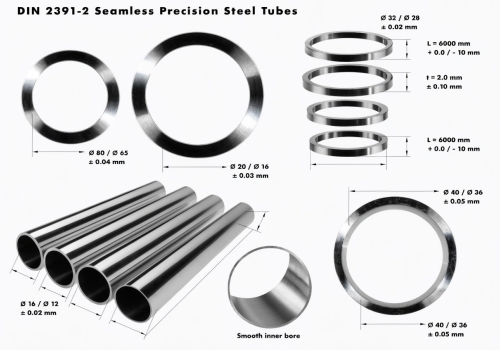
Project delays often happen when pipe dimensions fail strict limits. You lose money and time. I will show you how the right precision tubes solve this exact problem. A din 2391-2 seamless precision tube is a cold-worked steel pipe built to German industrial standards. It offers high dimensional accuracy, specific delivery conditions, and exact tolerances. Engineers use it mainly in mechanical and automotive systems where exact measurements matter most.
You might think all seamless pipes do the same job. This wrong idea will ruin your next big project. I want to explain why this specific standard matters for your sourcing needs.
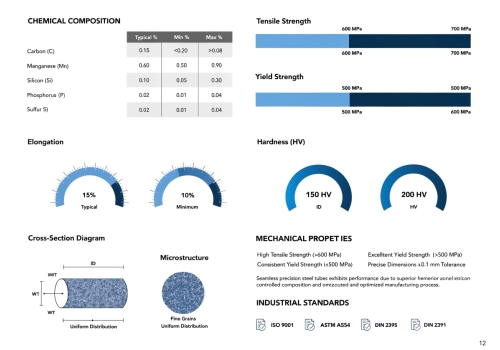
Weak steel bends under pressure and ruins your equipment. Your clients will blame you for failures. You must pick the right steel grade to stop structural damage. The properties depend on the steel grade, like St35 or St52. Carbon, silicon, and manganese make up the chemical mix. These elements decide the tensile strength and yield point. You get exact outer diameters and wall thicknesses that meet strict tolerance limits.
I remember a time when a client used weak tubes for a hydraulic cylinder. The cylinder burst under pressure. We had to replace everything. This taught me to always check the chemical mix and mechanical strength.
You must know the exact elements inside the steel. Elements like carbon (C) and manganese (Mn) give the tube its core strength. We test every batch to make sure no harmful elements ruin the steel.
| Standard | Grade | Material No. | C (%) | Si (%) | Mn (%) | P (%) | S (%) |
|---|---|---|---|---|---|---|---|
| DIN2391 | St 30 Si | 1.0211 | ≤0.10 | ≤0.10 | ≤0.55 | ≤0.025 | ≤0.025 |
| St 30 Al | 1.0212 | ≤0.10 | ≤0.05 | ≤0.55 | ≤0.025 | ≤0.025 | |
| St 35 | 1.0308 | ≤0.17 | ≤0.35 | ≥0.40 | ≤0.025 | ≤0.025 | |
| St 45 | 1.0408 | ≤0.21 | ≤0.35 | ≥0.40 | ≤0.025 | ≤0.025 | |
| St 52 | 1.0580 | ≤0.22 | ≤0.55 | ≤1.60 | ≤0.025 | ≤0.025 |
Your engineers need exact sizes. The outer diameter ranges from 4 to 260 mm. The wall thickness goes from 0.5 to 25 mm. We make the length between 4 and 7 meters. The tolerance for the outside diameter stays at ± 0.01 mm. The surface smoothness Ra value stays below 6.3 micrometers. We also keep the ovality tight at 0.1 mm. The straightness never goes past 1 mm per meter.
Different grades offer different strength levels. St52 gives you high strength and works great for welding. I always suggest St52 for heavy mechanical parts.
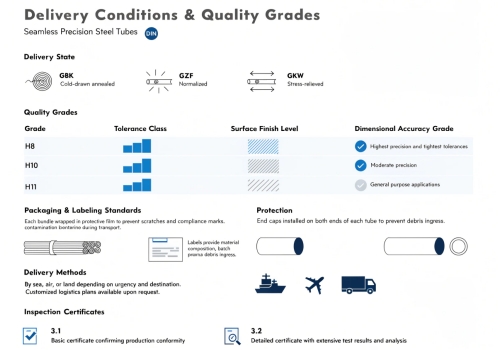
Choosing the wrong delivery state causes cracks during bending. Your workers will waste hours fixing bad pipes. Understanding delivery conditions prevents costly workshop errors. You can buy a din 2391-2 seamless precision tube in different conditions like cold finished or annealed. The standard offers Grade A for basic needs and Grade C for custom project rules. You must match the delivery condition to your bending and machining plans.
I once saw an EPC contractor order hard cold-finished tubes for tight bends. The tubes cracked instantly. They lost a week of work. We helped them switch to annealed tubes, and the problem stopped.
You have two choices for quality. Grade A acts as the basic option. We use Grade A for standard parts that do not need special certificates. Grade C serves custom needs. You pick Grade C when your project demands special testing or unique shapes.
You must know how the factory treats the steel after cold working. The treatment changes how the steel acts during your work.
| Designation | Symbol (DIN) | Symbol (EN) | Description |
|---|---|---|---|
| Cold finished (hard) | BK | +C | No heat treatment happens after cold forming. It resists deformation. |
| Cold finished (soft) | BKW | +LC | Heat treatment happens, then light cold drawing. You can bend it a little. |
| Cold finished and stress-relieved | BKS | +SR | Heat treatment removes stress. You can machine it safely. |
| Annealed | GBK | +A | We anneal the tube in a safe gas space. |
| Normalized | NBK | +N | We normalize it above the top transformation point. |
You might see other names in the market. DIN 2391 is the old German rule. EN 10305-1 is the new European rule. You can also compare it to ASTM A519 or GB/T 3639.
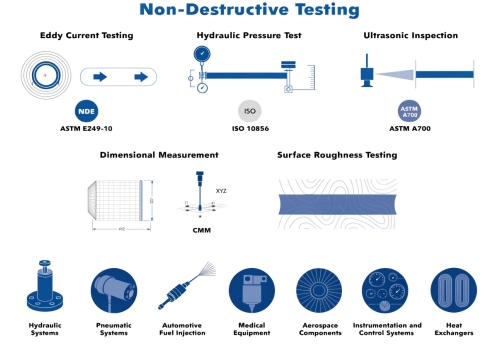
Hidden leaks destroy hydraulic systems after installation. Finding a leak late costs thousands of dollars. Proper testing guarantees your pipes hold fluid safely. Factories test every din 2391-2 seamless precision tube for exact dimensions and visual flaws. We use non-destructive tests to find tiny leaks. Engineers use these safe tubes in shock absorbers, steering parts, and heavy construction machinery where high-pressure fluids flow.
A site manager once called me at night because a cheap pipe leaked oil all over his clean factory floor. He bought from a bad supplier. At Centerway Steel, we test everything before we ship it to avoid these nightmares.
We perform many tests on every batch. We do chemical checks and tensile tests. We flatten the tubes to check their strength. We verify the sizes and look at the surfaces. We do non-destructive testing (NDT) on every single tube to stop leaks.
Cold-worked pipes in BK or BKW states have grease on them. Heat-treated pipes in BKS, GBK, or NBK states might look scorched. They must not have loose oxide scale. We accept tiny dents if the size stays within limits. We never allow scabs or laminations.
You will find these tubes in important places. We sell them for hydraulic and pneumatic control systems. Car makers use them for driveshafts and shock absorbers. Construction teams use them for heavy machinery frames. You should pick these precision tubes over normal seamless pipes when you need a tight, dynamic seal. Normal pipes just move fluid, but precision tubes handle high pressure and exact movement.
A din 2391-2 seamless precision tube gives you exact sizes and strong mechanical limits. You must pick the right grade and delivery state to build safe, long-lasting hydraulic systems.